


24 October 2026
Read Article
Free Shipping on all UK orders | Shop Collection
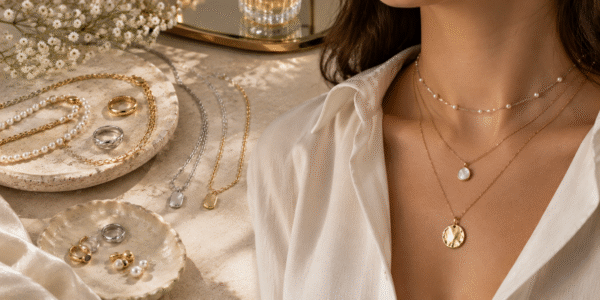
Layering necklaces can completely change the way a simple outfit looks.
A single necklace can add a quiet detail to an outfit. Two or three carefully chosen pieces can create something much more personal.
But good necklace layering is not simply about putting several chains around your neck.
The lengths need to work together. The shapes should have enough space to be seen. Different textures can create contrast, while similar designs can help a layered look feel connected.
Gold chains, silver necklaces, pendants and pearl designs can all play a role.
The trick is knowing how to combine them without making the result feel crowded.
Whether you prefer delicate jewellery or more distinctive pieces, this guide explains how to build a necklace stack that feels considered, comfortable and genuinely personal.
Necklace layering means wearing two or more necklaces together, usually at different lengths.
The simplest combination might be a short chain with a slightly longer pendant.
A more detailed stack could include three or four pieces with different textures, shapes and proportions.
The purpose is not necessarily to make your jewellery more noticeable.
It is about creating depth.
A single necklace creates one visual point.
Several necklaces can create movement from the neckline down towards the centre of the outfit.
That is why the distance between each piece matters so much.
If two necklaces sit directly on top of each other, they can visually merge.
Give them some space and each piece becomes easier to appreciate.
One of the easiest mistakes when layering necklaces is choosing the jewellery first and thinking about clothing afterwards.
Try reversing that process.
Look at the neckline you are wearing.
A necklace should work with the shape of the clothing beneath it.
A V-neck naturally creates a vertical space for necklaces.
A shorter chain can sit near the collarbone, while a longer necklace can follow the direction of the neckline.
A higher neckline can provide a simple background for a necklace stack.
This is particularly effective with pieces that sit above or just below the neckline.
An open shirt gives you more freedom.
You can create a layered look inside the opening, allowing different necklace lengths to remain visible.
This gives necklaces more visual space.
A simple chain can look particularly elegant here, while several layers can create a stronger focal point.
The important thing is to think about the whole outfit rather than treating the necklace as an isolated accessory.
There is no magic number.
For most people, two necklaces are the easiest place to start.
Three creates more depth.
Four or more can create a stronger statement, but proportion becomes increasingly important.
Think about the pieces you are using.
Two very delicate necklaces may still look subtle.
Two heavy chains can create a much stronger effect.
A delicate chain, a pendant and a pearl necklace will produce something completely different again.
So instead of counting necklaces, think about visual weight.
A simple way to build a necklace stack is to think in three levels.
This creates the foundation.
It usually sits close to the collarbone and provides the first point of detail.
A simple chain works particularly well here.
This adds separation.
It can introduce a different chain texture, pendant or slightly stronger design.
This creates the final layer and gives the stack a sense of length.
It can be particularly useful with simple tops, open shirts and dresses.
The three pieces do not need to match.
In fact, they often look more interesting when they do not.
Gold chains are particularly useful for necklace layering because they can provide structure without necessarily becoming the focal point.
A simple chain can sit close to the neckline while a pendant or more distinctive necklace occupies the next level.
The Saras necklace collection includes several chain-based and statement designs, including Amanda Chain, Bita Rope and Delnaz Herringbone Necklace.
Each can contribute something different to a layered look.
The important thing is to avoid choosing three pieces that all have exactly the same visual weight.
If your first necklace is delicate, consider making the second one slightly more noticeable.
If your first necklace already has a strong texture, a simpler chain may provide better balance.
A delicate chain is often treated as a piece that should be worn alone.
It does not have to be.
Its subtle appearance can make it particularly useful as the first layer of a necklace stack.
The chain establishes a line around the neck without competing with the pieces beneath it.
This is where a design such as the Amanda Chain can become useful within a wider jewellery collection.
Rather than making it the entire focus, you can use a simple chain as the foundation and introduce another design below it.
Amanda Chain is currently part of Saras’ necklace collection.
Not every necklace needs to sit quietly in the background.
A herringbone design has a naturally strong visual presence because of the way its surface catches and reflects light.
That means you may not need several additional pieces around it.
The Delnaz Herringbone Necklace is one of the current necklace designs at Saras and can be considered when you want a layer with more visual presence.
If you choose a stronger necklace as your central piece, keep the surrounding layers relatively simple.
This creates contrast rather than competition.
A rope-style chain naturally creates texture because of its twisted construction.
The result can be more visually noticeable than a very fine chain.
The Bita Rope is currently part of the Saras necklace collection.
A piece like this can work particularly well when worn on its own or used as the stronger layer within a more restrained necklace stack.
If one necklace already has a lot of texture, there is no need for every other piece to have the same level of detail.
Let the strongest piece breathe.
Mixing gold and silver can make a necklace stack feel more individual.
You do not necessarily need every piece to be made from the same metal colour.
The key is to create a connection between the pieces.
For example, you could combine:
Or reverse the balance:
The important part is proportion.
If the metals are different but the designs have similar levels of visual weight, the combination can feel deliberate.
You can also repeat one metal colour.
For example, two gold pieces surrounding one silver necklace create a different effect from an equal gold-and-silver split.
There is no single correct combination.
Experimentation is part of the appeal.
There is a difference between mixing metals and simply wearing everything you own.
If you are combining gold and silver, look for another connection.
It could be:
Two necklaces may have curved or geometric details.
A delicate silver chain may work better with a delicate gold chain than with an extremely heavy one.
A textured gold piece can work with a similarly detailed silver design.
A pearl, pendant or charm can visually connect otherwise different necklaces.
The result should feel like a collection rather than an accident.
Pendants introduce another consideration.
They are not simply another necklace length.
They create a focal point.
If you have a pendant necklace, allow enough space around the pendant for it to remain visible.
For example:
Short chain
↓
Medium-length pendant
↓
Longer simple chain
This gives the pendant room to become the centre of attention.
If you put another large pendant directly beneath it, the two pieces may compete.
When layering, not every necklace needs to make a statement.
Some pieces should provide the background.
Pearls introduce a different visual texture from metal.
That makes them particularly useful when building a layered necklace stack.
A pearl necklace can soften a collection dominated by chains.
The Saras necklace collection currently includes several pearl-focused designs, including Atousa Pearl Necklace, Avandis Pearl and Jina Pearl Necklace.
You could combine a pearl necklace with a simple gold chain, for example, allowing the difference in texture to create the visual interest.
Pearls do not have to be reserved for formal occasions.
A simple pearl necklace can work with a plain T-shirt, open shirt or knitwear just as easily as it can with evening clothing.
Layering is not always the answer.
Sometimes a single necklace looks better.
This is particularly true when the necklace itself has:
The more interesting the individual piece, the less support it may need.
A necklace does not have to be part of a stack to make an impression.
If you prefer understated jewellery, keep your layers simple.
Try:
One fine chain
One slightly longer necklace
That’s it.
The difference in length creates enough visual separation without making the neck area feel busy.
You can also keep the metal consistent.
Two gold necklaces can create a polished, cohesive look.
Two silver necklaces can feel clean and contemporary.
Minimalism does not mean wearing only one piece.
It means giving each piece enough space.
If you prefer jewellery with more personality, introduce variation.
Try combining:
But choose one element to act as the focal point.
For example:
Fine chain
→ foundation
Herringbone necklace
→ main texture
Pearl necklace
→ softer contrast
This creates three different visual roles instead of three necklaces competing equally.
Length is one of the most important parts of layering.
A short necklace draws attention towards the collarbone.
A medium-length necklace moves the eye further down.
A longer necklace creates more vertical movement.
You can therefore change the appearance of an outfit simply by changing the spacing between your necklaces.
This is particularly useful if you wear the same basic wardrobe regularly.
The clothes do not need to change.
Your jewellery can.
An open shirt is one of the easiest outfits for necklace layering.
The space between the collar creates a natural frame.
Try starting with a short chain and adding a second necklace below it.
If you want something more expressive, introduce a pendant or pearl piece.
A longer necklace can also work particularly well if the shirt is plain.
The simpler the clothing, the more freedom you have to experiment with jewellery.
Knitwear can create a very different background from a shirt.
Chunkier fabrics already have texture.
This means delicate necklaces can sometimes provide a useful contrast.
A fine chain against a simple knit can look understated.
A slightly stronger necklace can become more noticeable.
If the knit has a high neckline, consider a necklace that sits above or below it rather than disappearing directly into the fabric.
Again, the aim is contrast.
There is no reason for every necklace stack to look the same.
Two delicate necklaces.
A simple gold chain with a refined pendant.
Mixed metals and contrasting chain textures.
Gold or silver combined with pearls.
One substantial necklace supported by simpler layers.
Your jewellery should reflect how you actually dress.
A complicated stack may look beautiful in a photograph but feel completely unnatural if your everyday style is very minimal.
Choose something you can imagine wearing outside the jewellery box.
One of the less glamorous realities of layering is that necklaces can tangle.
Different chain lengths help, but they do not guarantee that everything will stay perfectly separated.
To reduce tangling:
If you regularly layer necklaces, you may also want to look for designs that sit naturally rather than constantly moving into the same position.
Movement is not necessarily a problem.
In fact, part of the charm of layered jewellery is that it changes as you move.
But if every necklace ends up in exactly the same place, the stack may lose its structure.
Try increasing the difference between necklace lengths.
You can also change which necklace sits closest to the neck.
Sometimes simply switching the order of two pieces makes the whole combination work better.
For everyday styling, simplicity usually makes the most sense.
A useful combination could be:
Short gold chain
medium-length pendant
simple bracelet or ring
You do not necessarily need three necklaces.
A two-piece stack can look complete.
The beauty of a versatile gold necklace is that you can wear it alone one day and combine it with another piece the next.
That makes your jewellery collection feel larger without requiring you to buy more.
Silver can be particularly effective when you want a cooler, cleaner jewellery aesthetic.
Try combining two silver necklaces with different textures.
For example:
Or:
If you prefer mixed metals, add one gold piece rather than changing the entire stack.
A small amount of contrast can be enough.
Gold and pearls offer a natural contrast.
The gold introduces warmth and shine.
The pearl introduces a softer, organic surface.
This makes the combination particularly useful when you want a necklace stack that feels elegant without being overly formal.
The current Saras collection includes Atousa Pearl Necklace and Jina Pearl Necklace, alongside several gold necklace and chain designs.
You could use a pearl necklace as the focal point and keep the gold chain relatively simple.
Or reverse the roles and allow a stronger gold chain to lead while the pearl necklace adds a softer layer.
A good necklace stack needs hierarchy.
Ask yourself:
Which necklace should someone notice first?
That is your focal piece.
Everything else should support it.
If your focal piece is a large pendant, keep the surrounding chains delicate.
If your focal piece is a textured chain, choose simpler pieces around it.
If your focal piece is a pearl necklace, avoid adding another highly detailed necklace directly beside it.
This small decision can make a huge difference.
If you are new to layering, try this:
Choose one necklace you already wear regularly.
Add a second necklace with a noticeably different length.
Make sure the two pieces have different visual weights.
Wear them with a simple neckline.
Only add a third necklace if you feel the combination needs it.
This prevents the most common mistake:
Adding more jewellery before understanding whether the first two pieces work together.
Saras’ current necklace collection includes 16 designs, ranging from chains and pearl necklaces to more distinctive pendant and statement pieces.
Some of the designs that can be explored when building different necklace combinations include:
The variety is useful because a necklace collection does not have to revolve around one particular shape.
You can have a simple everyday chain, a pearl piece, a more distinctive pendant and a stronger chain for different outfits and occasions.
For example, the Hengam Necklace is currently described by Saras as a clean 18ct solid gold necklace with a 40cm length, making it a useful example of a shorter, simple necklace that can also be considered when building a layered look.
You do not need a large number of necklaces.
Instead, look for variety of purpose.
Something simple enough to wear frequently.
A piece with a stronger design or texture.
For days when you want a clear focal point.
For softer contrast.
Useful for layering and creating vertical movement.
This gives you far more combinations than buying five necklaces that all perform exactly the same role.
Layering should not mean sacrificing quality for appearance.
Because several necklaces move against each other, construction and care remain important.
Before buying, look at:
Saras’ own quality jewellery guide recommends looking beyond photographs and considering the metal, construction, finishing and suitability of a piece for the way it will actually be worn.
That advice becomes particularly relevant when several pieces are being worn together.
Layered jewellery needs the same basic care as jewellery worn individually, but there is one additional consideration: friction.
Different necklaces can move against each other throughout the day.
To help keep them in good condition:
Saras recommends storing jewellery separately and avoiding harsh chemicals and abrasive surfaces for its gold jewellery.
For silver jewellery, regular care is also useful because sterling silver can naturally tarnish over time.
There is really only one rule worth remembering:
Every necklace should have a reason for being there.
One provides length.
Another provides texture.
Another introduces a pendant.
Another adds colour or a pearl.
If every piece is doing the same thing, the stack can quickly become visually crowded.
But when each necklace has a different role, even three or four pieces can feel balanced.
That is what makes a good necklace stack look effortless.
Necklace layering is less about following jewellery trends and more about understanding proportion.
Start with the neckline.
Choose your shortest piece.
Add space.
Introduce a different texture.
Decide whether you want gold, silver or a combination of both.
Then decide which necklace should be the focal point.
You might prefer the simplicity of a delicate gold chain and one pendant.
You might enjoy combining silver and gold.
Or you might prefer a pearl necklace surrounded by understated chains.
There is no single way to build a beautiful necklace stack.
The most successful combination is usually the one that feels natural with the way you already dress.
And that is ultimately what good jewellery should do.
It should not make you feel as though you are wearing a trend.
It should feel like your style.
Two necklaces are a good starting point. Three can create more depth, while four or more can create a stronger statement. The important factor is the visual weight and spacing of the pieces rather than the exact number.
Yes. Gold and silver can be combined successfully when the proportions, lengths or design details create some visual connection.
There is no single ideal length. The important thing is to create enough separation between the necklaces so that each piece remains visible.
Yes. Pearls and gold create an interesting contrast between soft organic texture and polished metal.
No. They can coordinate without being identical. Different textures, lengths and proportions often make a layered look more interesting.
Yes. A pendant can work particularly well as the middle or longest layer. Give it enough space so that the pendant remains visible.
Use noticeably different lengths, avoid combining too many extremely fine chains and vary the construction of the pieces. Some movement is normal when wearing multiple necklaces.