


14 September 2026
Read Article
Free Shipping on all UK orders | Shop Collection
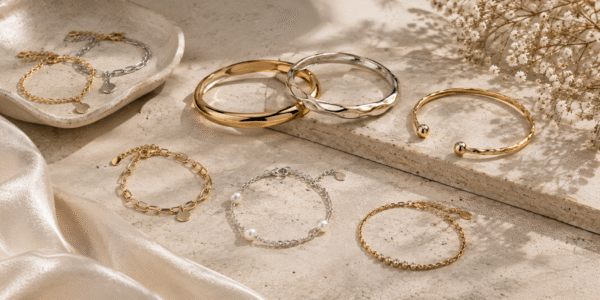
Bracelets and bangles have a different relationship with the body than most other pieces of jewellery.
A necklace sits relatively still. Earrings frame the face. Rings remain visible whenever you look down at your hands.
A bracelet moves.
It catches the light when you reach for a coffee, push back a sleeve or gesture during a conversation. A bangle can make a quiet statement with a simple outfit, while a fine chain bracelet may become part of your everyday style almost without you noticing it.
That movement is part of what makes wrist jewellery so interesting.
But choosing the right piece is not always straightforward.
Should you choose a bracelet or a bangle? A delicate chain or something more sculptural? Gold or silver? Should you wear one piece on its own, or combine several together?
The answer depends on more than current trends.
The shape of your wrist, the clothes you wear, the jewellery you already own and the way you move through everyday life can all influence which pieces you actually enjoy wearing.
At Saras Fine Jewellery, the bracelet collection includes a variety of chain bracelets, bangles and pearl designs, making it possible to explore different approaches to wrist styling rather than relying on a single type of jewellery.
The words bracelet and bangle are sometimes used interchangeably, but they generally describe different types of jewellery.
A bracelet is usually designed to move or flex around the wrist. It may use a chain, clasp, links or another flexible structure.
A bangle is typically more rigid.
It keeps its shape around the wrist rather than moving like a chain bracelet.
That structural difference can completely change the way a piece looks and feels when worn.
Neither is automatically better.
They simply create different effects.
A delicate chain bracelet can become an everyday essential, while a sculptural bangle may feel more like the main feature of an outfit.
For many jewellery lovers, having both creates more styling possibilities.
Before choosing a bracelet, think about how it will fit into your actual life.
This sounds obvious, but it is surprisingly easy to buy jewellery for an imaginary version of your wardrobe.
You may love the appearance of a substantial statement bracelet, but if you usually wear fitted sleeves, work at a desk or prefer minimal jewellery, a more delicate design might become the piece you reach for most often.
Start with a few practical questions.
How often will you wear it?
Will it be your only wrist accessory?
Do you normally wear a watch?
Do you prefer jewellery that moves freely?
Do you like a close fit or a little more movement?
Are you hoping to layer it with other pieces?
These questions can be more useful than simply deciding whether you like gold or silver.
The best everyday bracelet is usually one that feels natural.
You should not constantly be adjusting it.
You should not need to build an entire outfit around it.
And ideally, it should work with more than one type of clothing.
For everyday wear, many people prefer:
A chain bracelet can be particularly useful because it offers visual detail without taking over an outfit.
This is also where a design like the Amanda Bracelet can fit naturally into a jewellery collection.
Rather than thinking about it as a piece that needs a special occasion, consider how a simple bracelet can become part of your daily rotation alongside rings, earrings or a necklace.
The best everyday jewellery is often the jewellery you stop overthinking.
You simply put it on.
A bangle creates a more defined outline around the wrist.
Because it keeps its structure, it can have a stronger visual presence than a fine chain.
That makes bangles particularly useful when you want one piece of jewellery to do more of the work.
You may choose a bangle if you:
The Negin Bangle is a natural product to mention in this context because the collection itself gives customers an option that is clearly positioned as a bangle rather than another chain bracelet.
A structured piece like this can work particularly well when the rest of your jewellery is relatively minimal.
You do not always need earrings, a necklace, rings and several bracelets at the same time.
Sometimes one interesting piece around the wrist is enough.
Gold and silver bracelets can create very different visual effects.
Gold tends to bring warmth to the wrist and can work beautifully alongside other gold jewellery.
Silver has a cooler appearance and can feel especially clean, modern and understated.
But choosing between them should not be based entirely on colour.
Think about the jewellery you already wear.
If most of your collection is gold, a gold bracelet may integrate naturally with your rings and necklaces.
If you wear a lot of sterling silver, a silver bracelet can become part of a consistent everyday look.
You can also mix metals.
More on that later.
At Saras, gold and silver are both part of the wider jewellery collection, with the brand describing its jewellery as including solid 18ct gold and handcrafted sterling silver.
Gold can be a good choice if you prefer:
Silver may appeal to you if you prefer:
The important thing is that you do not have to commit to one forever.
A jewellery collection can change.
Size can make a bigger difference than many people expect.
A bracelet that is too loose may move excessively around the wrist.
A bracelet that is too tight may feel uncomfortable and restrict natural movement.
The ideal fit depends partly on the type of bracelet.
A fine chain bracelet may look beautiful with a small amount of movement.
A heavier bracelet may feel more comfortable when it sits more securely.
Bangles work differently because their structure does not adjust around the wrist in the same way as a chain.
Before buying online, check the measurements carefully.
Saras provides bracelet size information and notes that bracelet sizes refer to the total chain length, with many pieces featuring adjustable chains.
If you are unsure, measure a bracelet you already enjoy wearing.
That is often more useful than trying to guess from a photograph.
Bracelet stacking is one of the easiest ways to make a jewellery collection feel more personal.
But there is a difference between layering and simply putting everything on at once.
A good bracelet stack usually has variation.
Try combining different:
For example, you might combine:
A fine chain bracelet
with a slightly stronger linked bracelet
and one structured bangle.
The contrast creates interest.
If you have never layered bracelets before, do not begin with five.
Start with two.
For example, a simple chain bracelet alongside a bangle.
Wear them for a day.
Notice how they move together.
Do they catch on your clothing?
Do they feel comfortable?
Do you like the visual balance?
From there, you can add another piece.
Jewellery styling works better when you give each piece some space.
One of the most effective bracelet combinations is a flexible chain alongside a structured bangle.
The contrast is already built into the materials.
One moves.
One holds its shape.
One can feel relaxed.
One can feel more architectural.
This is a useful way to create a layered look without relying on colour or gemstones.
For example, you could style a chain design from the Saras bracelet collection alongside a bangle such as the Negin Bangle.
The goal is not for the pieces to match perfectly.
The goal is for them to create contrast while still looking intentional.
Every stack benefits from one piece that feels slightly more important.
That does not necessarily mean the biggest piece.
It could be:
The other pieces should support it.
This is particularly useful if you are styling several bracelets at once.
Instead of making every piece equally bold, choose one focal point and keep the others simpler.
The Sadaf Pearl Bangle, for example, can naturally serve as a more distinctive element within a wrist stack because pearl introduces a different texture and visual character from plain metal.
Pearls can completely change the personality of wrist jewellery.
A plain metal bracelet may feel modern and minimal.
Add pearls, and the result can become softer and more expressive.
Pearl jewellery also creates contrast.
The surface of metal reflects light differently from the softer appearance of a pearl.
That contrast means you do not necessarily need a complicated design.
A simple pearl detail can be enough.
Saras’ bracelet collection includes both Morasheen Pearl and Sadaf Pearl Bangle, giving you an opportunity to include pearl pieces naturally within the article and your internal linking structure.
Try pairing:
A pearl bracelet or bangle
with simple gold or silver earrings
and one understated ring.
This keeps the pearl jewellery from competing with too many other elements.
This is one of the most practical styling questions.
Can you wear a bracelet and a watch together?
Yes.
But proportion matters.
If your watch is large and substantial, a delicate bracelet may provide balance.
If your watch is minimal and slim, you have more freedom to introduce a stronger bracelet or bangle.
You can also wear them on opposite wrists.
There are no strict rules.
However, if you wear your bracelet directly beside a watch, think about movement and contact.
Jewellery pieces that constantly rub against each other may eventually show signs of surface wear.
For a more comfortable look, consider spacing the pieces slightly or choosing designs that do not constantly collide.
Absolutely.
The idea that all jewellery must be the same metal is becoming increasingly limiting.
Gold and silver can work together particularly well around the wrist because bracelets already create natural movement and separation.
A mixed-metal stack can feel intentional when there is another connection between the pieces.
That connection could be:
For example, you might combine a fine silver bracelet with a warmer gold bangle.
Or introduce a silver piece between two gold bracelets.
The trick is balance.
If the stack already includes several strong shapes, keep the metal combination simple.
If the pieces are very minimal, you can experiment more freely.
You do not need to follow the old rule that everything must match.
There is no correct number.
One bracelet can look complete.
Two or three can create a layered look.
A larger stack can become a major part of your outfit.
The better question is:
How much visual attention do you want around your wrist?
Best for a clean and understated look.
Easy to style and usually enough to create contrast.
Allows you to introduce different textures and proportions.
Creates a stronger statement and works best when the pieces have a clear relationship.
If you are wearing several bracelets, consider simplifying your rings or necklace.
Jewellery looks more balanced when not every area is competing for attention.
A bracelet can change depending on where you wear it.
You do not need separate jewellery for every situation, but it helps to understand how different styles behave.
Choose comfort and versatility.
Fine chains and simpler designs often work well because they do not dominate an outfit.
The Amanda Bracelet or Shinna Bracelet can be introduced here as products for readers to explore based on the specific style and details they prefer.
Keep the jewellery practical.
Consider whether it will catch on sleeves, make contact with a desk or interfere with your normal routine.
A simple bracelet can add detail without becoming distracting.
This is where you can introduce more visual presence.
A stronger chain, bangle or pearl piece can become part of the outfit.
Choose something that feels different from your everyday jewellery.
You might introduce a more substantial design, pearl detail or a piece that becomes the focal point of your wrist styling.
Chain bracelets can look completely different depending on their construction.
A fine chain can feel delicate.
A thicker chain can feel bold.
A textured chain can create more visual interest even when the overall design remains simple.
The Saras bracelet collection includes several chain-based pieces, including Aram Chain, Raha Chain and Yas Chain.
This gives you an excellent opportunity to build product mentions into the article naturally.
For example:
If you prefer chain jewellery with more visual presence, explore designs such as the Aram Chain or Yas Chain.
A chain design such as Raha Chain can be introduced as an option to consider when comparing different proportions and structures within a layered wrist look.
Your bracelet does not need to follow a trend.
It should fit naturally into the way you dress.
Choose:
Avoid adding detail simply because you think a stack needs to look more impressive.
Sometimes one piece is enough.
Experiment with:
You can create a stronger look without necessarily choosing larger jewellery.
Texture can be just as effective.
Consider:
A pearl bracelet can add a different dimension to a jewellery collection dominated by metal.
Try:
The design itself can become the statement.
Not necessarily.
Matching jewellery can create a polished look, but it is not the only option.
You might wear:
A gold bracelet
with silver earrings.
A pearl bangle
with a simple gold necklace.
A structured bangle
with a delicate ring.
The goal is coordination rather than duplication.
Look for small connections between your pieces.
Perhaps the curves are similar.
Maybe the proportions are balanced.
Or perhaps one material appears in more than one area.
Perfect matching is not required.
In fact, a slightly varied collection can often feel more personal.
Bracelets often experience more physical contact than earrings or necklaces.
They can touch desks, clothing, watches, bags and other jewellery throughout the day.
For this reason, care matters.
Avoid unnecessary exposure to harsh chemicals.
Remove jewellery when there is a high risk of physical impact.
Store bracelets separately where possible.
Clean them using an appropriate soft cloth and method for the material.
Saras advises owners of its 18ct gold jewellery to avoid harsh chemicals and abrasive surfaces and to store pieces separately to reduce scratching.
A bracelet does not need to be kept hidden away.
Jewellery is made to be worn.
But understanding where most wear occurs can help you care for it more thoughtfully.
Sterling silver can develop tarnish over time.
This is a natural surface reaction and does not automatically mean the jewellery is poor quality.
To keep silver bracelets looking their best:
Store them in a dry environment.
Avoid unnecessary exposure to harsh chemicals.
Clean them with a suitable method.
Avoid abrasive cleaning when dealing with delicate finishes or detailed surfaces.
If a piece is particularly valuable or delicate, professional advice may be the safest option.
For a more detailed explanation of sterling silver and its care, link readers to your existing Silver Jewellery: How to Choose, Wear and Care for Sterling Silver article.
A good bracelet collection does not need to be large.
Start with different purposes rather than different colours.
For example:
Something comfortable and versatile.
For occasions when you want more visual presence.
For structure and contrast.
For something softer or more expressive.
A piece that simply feels like you.
This approach gives your collection range.
You do not need five versions of the same chain bracelet.
Instead, choose pieces that allow you to style your wrist differently depending on your mood and outfit.
Saras currently offers ten bracelet designs across chain bracelets, bangles and pearl pieces, which makes the category suitable for this kind of collection-building approach.
Buying bracelets online requires a little more attention than simply looking at the photograph.
Check:
For precious-metal jewellery, also pay attention to the information provided about the material and hallmarking where applicable.
The Saras website provides product sizing guidance for bracelets and notes that individual product information should be checked for the specific piece.
A photograph can tell you whether you like a design.
The product details tell you whether it is likely to work for you.
You need both.
Bracelets are often underestimated.
People spend a lot of time choosing necklaces and earrings because they are immediately visible.
But wrist jewellery can quietly change an entire outfit.
A simple shirt can feel more considered with a fine bracelet.
A black dress can look completely different with a sculptural bangle.
A casual outfit can become more personal when several bracelets are layered together.
And a single pearl piece can soften an otherwise minimal look.
The versatility comes from movement.
A bracelet is never completely static.
It becomes part of the way you move.
The Saras bracelet collection offers different approaches to wrist jewellery rather than repeating the same design in slightly different forms.
You can explore chain styles such as:
Or consider more structured and distinctive pieces such as:
There are also pearl-focused designs including:
And smaller colour variations such as:
The current category includes these ten products.
The most useful approach is not to ask which one is objectively best.
Think about what your jewellery collection is currently missing.
Do you already have several delicate chains?
Perhaps a bangle would add contrast.
Do you mostly wear plain metal?
A pearl piece could introduce a softer element.
Do you rarely wear bracelets at all?
Start with one comfortable design that works with your everyday wardrobe.
Your collection can grow from there.
A bracelet is generally flexible and may use a chain or clasp, while a bangle is usually more rigid and keeps its shape around the wrist.
Yes. Mixing metals can create an interesting and modern look, particularly when the pieces share similar proportions or styling.
There is no fixed number. One bracelet can create a minimalist look, while two or three can form a balanced stack. Larger stacks work best when there is variation in texture and size.
The ideal fit depends on the design. A bracelet should generally be comfortable and allow natural movement without constantly slipping or feeling restrictive.
Yes. You can wear bracelets beside a watch or on the opposite wrist. Consider comfort and avoid excessive friction between jewellery pieces.
Many bangles can be suitable for everyday wear, depending on their design, fit and your normal activities. Structured bangles can create a stronger visual effect than delicate chain bracelets.
Start with two pieces and introduce variation in texture, width or structure. A chain bracelet paired with a bangle is a simple starting point.
Avoid harsh chemicals and unnecessary physical impact, store the piece separately where possible and clean it using an appropriate soft method.
Sterling silver can tarnish over time due to reactions with substances in the environment. Appropriate storage and cleaning can help maintain its appearance.
The best bracelet is not necessarily the most elaborate piece in your jewellery box.
It is the one that works with your life.
Perhaps that is a fine chain you wear every day.
Perhaps it is a sculptural bangle that transforms a simple outfit.
Perhaps it is a pearl piece you save for evenings.
Or perhaps you enjoy combining several different bracelets and changing the stack depending on your mood.
Gold and silver bracelets offer different possibilities, while bangles and chains create different types of movement and structure.
The key is to build variety.
Choose one piece for everyday wear.
Try another with more visual presence.
Add a bangle when you want structure.
Introduce pearls when you want contrast.
Over time, your bracelet collection becomes less about following jewellery rules and more about understanding what feels natural on your wrist.
Explore the Saras Fine Jewellery Bracelets Collection and compare the different chains, bangles and pearl designs to find the pieces that add something genuinely new to your collection.