


14 September 2026
Read Article
Free Shipping on all UK orders | Shop Collection
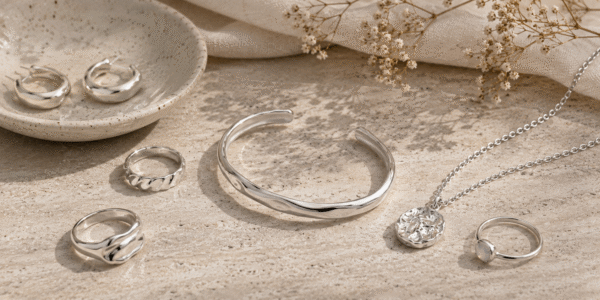
Silver jewellery has a particular advantage: it can be refined without feeling overly formal, distinctive without becoming difficult to wear, and versatile enough to work with everything from everyday clothing to occasion dressing.
But choosing a good piece of silver jewellery involves more than deciding whether you like its appearance.
The metal, construction, finish, proportions and even the way you intend to wear the piece can all affect whether it becomes something you reach for regularly or something that stays in the jewellery box.
For anyone considering silver jewellery, understanding the difference between sterling silver, plated jewellery and other materials is a useful starting point. It also makes it easier to recognise the details that separate a thoughtfully made piece from one that simply looks attractive in a photograph.
At Saras Fine Jewellery, the silver collection includes rings, earrings and bracelets made from 925 sterling silver, with selected designs incorporating materials such as Cubic Zirconia, natural baroque pearls and natural stones.
So, what should you actually look for when choosing silver jewellery?
When shopping for silver jewellery, one of the first terms you are likely to encounter is sterling silver.
Sterling silver is a silver alloy with a fineness of 925, meaning it contains at least 925 parts silver per 1,000 parts of the alloy. In the UK hallmarking system, 925 is the recognised fineness associated with sterling silver.
The reason silver is commonly alloyed rather than used in its purest form is practical. Jewellery needs to have properties that make it suitable for being shaped, finished and worn, rather than simply having the highest possible precious-metal content.
This is why the number stamped on a piece can tell you something useful about the material.
The number 925 refers to the fineness of the silver.
In simple terms:
925 = 92.5% silver
The remaining portion consists of other metals used to create the alloy.
This is why you may see jewellery described as:
These terms are closely connected, although a hallmark provides more information than simply seeing a number on a product.
There is a reason sterling silver remains one of the most widely recognised materials in jewellery.
It combines the visual qualities people associate with silver with the practical characteristics needed for jewellery making.
It can be polished to a bright finish, given a textured or sculptural surface, shaped into delicate forms or used for larger statement designs.
That versatility is particularly useful for contemporary jewellery.
A simple sterling silver ring can feel understated and architectural. A pair of sculptural earrings can make the same metal feel much more expressive.
At Saras, for example, the Aurea Organic earrings use 925 sterling silver in an organic sculptural design inspired by flowing natural forms.
That is one of the strengths of silver as a jewellery material: the metal does not dictate one particular aesthetic.
This distinction is worth understanding before buying.
Sterling silver jewellery is made from a sterling silver alloy.
Silver-plated jewellery, by contrast, consists of another underlying material with a layer of silver applied to its surface.
The two can look very similar when new, particularly in photographs.
Their construction, however, is different.
| Feature | Sterling Silver | Silver-Plated |
|---|---|---|
| Construction | Sterling silver alloy throughout | Silver layer over another material |
| Silver content | 925 fineness for sterling silver | Depends on the plating |
| Surface | Silver itself | Plated surface |
| Wear | Can be polished and maintained as silver | Plating can wear through over time |
| Long-term ownership | Suitable for jewellery collections | Often chosen as a more affordable option |
Neither option is automatically right for every buyer.
The important thing is knowing what you are actually purchasing.
If a product is described simply as “silver jewellery“, look for clear information about the material and fineness rather than assuming that every silver-coloured piece is sterling silver.
A beautiful photograph is a good reason to look twice.
It is not necessarily a good reason to buy.
When choosing quality silver jewellery, pay attention to several things.
Look for clear information about the material.
If you want sterling silver, check whether the product is described as 925 sterling silver.
At Saras, product pages provide the material information. For example, the Aven Ring is listed as 925 Sterling Silver with Cubic Zirconia stones, while the Elian Ring is also made from 925 Sterling Silver and features colourful Cubic Zirconia.
Examine how the piece is put together.
For a ring, consider the shape and finish of the band.
For earrings, look at the posts, backs and overall construction.
For bracelets, inspect the joins, clasps and areas that are likely to experience movement.
For a necklace, the chain and fastening deserve as much attention as the decorative element.
Silver can have many different finishes.
A highly polished surface reflects light dramatically.
A textured surface can create a softer and more tactile appearance.
A deliberately organic finish can make a piece feel less uniform and more sculptural.
The finish should suit the design rather than simply being added for decoration.
Jewellery is worn on the body.
That sounds obvious, but it is easy to forget when shopping online.
An impressive ring that feels uncomfortable after an hour is unlikely to become an everyday favourite.
The same applies to earrings, bracelets and necklaces.
Silver rings are particularly versatile because they can be worn alone, stacked or used as a more distinctive focal point.
When choosing a silver ring, consider its proportions first.
A narrow band can work well as an everyday piece and can usually be combined with other rings.
A wider ring has more visual presence and may work better as a standalone design.
Gemstones can change the character of a ring considerably.
For example, Saras’ Aven Ring combines a fine sterling silver band with four light green Cubic Zirconia stones arranged in a gentle curve.
The Elian Ring, by comparison, uses a wider polished band with colourful Cubic Zirconia stones.
Both are silver rings, but they create very different impressions.
That is why choosing jewellery by category alone is rarely enough.
The shape and proportions matter.
Earrings are one of the easiest ways to introduce silver into an existing jewellery collection.
Small studs can provide a subtle everyday detail.
Hoops can create a stronger silhouette.
Drop earrings can introduce movement.
Sculptural designs can become the main feature of an outfit.
The Aurea Organic earrings at Saras are an example of a more sculptural approach, using organic forms rather than relying on a conventional geometric silhouette.
The Luna Flow earrings take another approach, combining 925 sterling silver with natural baroque pearls. The natural character of each pearl means that the pieces have their own individual variation.
When choosing silver earrings, also consider weight and how long you normally wear earrings.
A dramatic design may be ideal for an evening but not necessarily the most practical choice for an entire working day.
Bracelets occupy an interesting position in a jewellery collection.
They are visible throughout the day but do not sit directly around the face like earrings or necklaces.
This makes them useful for adding texture and movement without dominating an outfit.
Silver bangles can create a stronger, cleaner silhouette, while a more delicate bracelet can work quietly alongside a watch or other jewellery.
Saras’ current silver selection includes designs such as the Amethyst Cuff Bangle, which is made from 925 sterling silver and incorporates three natural Dendritic Agate stones. Each stone has its own natural inclusions.
This kind of combination demonstrates how silver can act as a foundation for other materials rather than being the sole visual focus.
Silver does not have to be worn by itself.
One of the most interesting aspects of contemporary silver jewellery is the way the metal can be combined with stones, pearls and other details.
Pearls can soften the cooler appearance of silver and introduce natural variation.
Saras’ Luna Flow earrings combine sterling silver with natural baroque pearls, with each pearl naturally unique.
Cubic Zirconia can introduce colour and sparkle without changing the overall character of a silver design.
The Aven and Elian rings both use Cubic Zirconia in different ways.
Natural stones can create an entirely different visual effect because their patterns and inclusions can vary.
The Amethyst Cuff Bangle, for example, uses natural Dendritic Agate stones, each with its own inclusions.
This is particularly appealing if you prefer jewellery that does not look completely uniform.
Yes, sterling silver can tarnish over time.
Tarnishing is not necessarily a sign that your jewellery is poor quality.
Silver can react with substances in its surrounding environment and develop a darker or less bright surface over time.
The good news is that this does not mean the jewellery has been ruined.
With appropriate care and cleaning, silver jewellery can often be brought back to a much brighter appearance.
This is one reason it is useful to distinguish between tarnishing and physical damage.
Tarnishing affects the surface appearance.
Scratches, dents or structural damage are different issues.
Good jewellery care does not need to be complicated.
A few habits can make a noticeable difference.
Perfume, cleaning products and other chemicals can affect jewellery surfaces.
It is sensible to put jewellery on after applying cosmetics and fragrance rather than exposing it unnecessarily.
Rings and bracelets in particular can experience considerable friction during exercise, manual work or other physical activities.
Removing jewellery when appropriate can reduce unnecessary wear.
Silver jewellery can scratch when pieces rub against each other.
Store pieces separately where practical, particularly those with delicate surfaces or stones.
Avoid aggressive scrubbing.
A soft jewellery cloth can be useful for removing everyday residue and restoring some of the surface brightness.
If a piece has stones, pearls or a more complex construction, follow the care guidance appropriate to that specific item rather than assuming every piece can be cleaned in the same way.
Storage is often overlooked.
A jewellery box is not simply somewhere to put jewellery when you are not wearing it.
It can help protect pieces from unnecessary friction and environmental exposure.
Ideally:
The aim is simple: reduce unnecessary contact, moisture and exposure.
This is particularly important when shopping online.
In the UK, hallmarking provides an independent way of verifying precious-metal fineness. A full UK hallmark consists of three compulsory marks: the sponsor’s or maker’s mark, the metal and fineness mark, and the Assay Office mark.
For sterling silver, the recognised fineness is 925.
There are also exemptions based on weight, so the absence of a hallmark does not automatically mean that every small silver item is not genuine. The UK guidance currently gives a minimum exemption weight of 7.78 grams for silver.
For online shoppers, the British Hallmarking Council recommends checking where the seller is based and looking for appropriate hallmarking information.
This is particularly relevant when purchasing precious-metal jewellery from unfamiliar websites.
Hallmarking is more than a tiny collection of symbols stamped somewhere on a piece.
It exists as a form of consumer protection.
According to UK government guidance, a hallmark indicates that a precious-metal item has been independently tested and verified against its described purity or fineness.
For someone buying silver jewellery online, this provides useful reassurance.
It also means that buyers can compare pieces based on actual metal information rather than simply relying on photographs or descriptions.
If you are spending money on precious-metal jewellery, that distinction matters.
It can be.
But “everyday wear” means different things depending on the piece.
A small pair of silver earrings may experience relatively little contact during the day.
A ring can come into contact with desks, door handles, bags and other objects constantly.
A bracelet may rub against clothing, watches and surfaces.
A necklace can be relatively protected but may still encounter perfume, cosmetics and clothing.
So instead of asking whether silver jewellery is suitable for everyday wear in general, consider the individual piece and how you use it.
The design, construction and your lifestyle all matter.
Silver is particularly easy to style because it does not require an elaborate outfit.
Choose one or two simple pieces.
A small silver ring with understated earrings can be enough.
Combine different proportions rather than choosing several pieces that are almost identical.
A delicate necklace can sit alongside another necklace with a different length or pendant.
A sculptural earring, statement ring or pearl detail can provide more visual impact without requiring multiple pieces.
Simple silver jewellery can work with denim, knitwear, shirts and neutral clothing particularly easily.
The best styling rule is also the simplest:
Wear jewellery that works with your clothes rather than competing with them.
There is no universal winner.
Gold and silver create different visual effects, and the right choice often comes down to personal preference.
Silver tends to create a cooler, brighter appearance.
Gold introduces a warmer tone.
Your existing wardrobe may also influence the choice.
If you already own a large gold collection, adding silver can introduce contrast.
If most of your jewellery is silver, continuing with the same metal can make layering easier.
You can also mix metals.
There is no jewellery rule saying that every piece you own must be the same colour.
Mass-produced jewellery often aims for consistency.
Handcrafted jewellery can have a different character.
Small variations in texture, shape or natural stones can become part of the identity of a piece rather than something that needs to be eliminated.
This is particularly noticeable when jewellery incorporates natural materials.
For example, Saras’ Amethyst Cuff Bangle uses natural Dendritic Agate stones with individual inclusions, while Luna Flow incorporates natural baroque pearls.
If you prefer jewellery that feels less uniform, these details can be part of the appeal.
Silver jewellery can also make a thoughtful gift because it does not require the same level of size certainty as some other jewellery purchases.
Earrings and necklaces can be easier choices when you do not know someone’s exact ring size.
If you are buying a ring, however, getting the correct size is important.
Think about the person’s existing style.
Do they wear minimalist jewellery?
Do they prefer statement pieces?
Do they usually wear silver?
Do they like pearls or colourful stones?
A gift does not have to be expensive to feel considered.
Choosing something that fits the person’s existing style is often more meaningful than simply choosing the most elaborate piece.
A good jewellery collection needs variety.
Silver can provide that variety without requiring a completely different design language.
You can have:
The common material creates some visual consistency while the designs provide personality.
That makes sterling silver particularly useful for people who enjoy building their collection gradually.
Saras’ current Silver Jewellery collection contains 35 products spanning different styles and categories.
The collection includes silver rings such as Aven and Elian, sculptural earrings including Aurea Organic, pearl designs such as Luna Flow and statement bracelet designs such as the Amethyst Cuff Bangle.
This makes the collection suitable for different approaches to wearing silver — from understated everyday pieces to more distinctive jewellery designed to become a focal point.
You can explore the full collection here:
Yes. In the UK hallmarking system, 925 is the recognised fineness associated with sterling silver, meaning 925 parts per thousand are silver.
Yes. Sterling silver can tarnish over time as its surface reacts with substances in the environment. Proper storage and appropriate cleaning can help maintain its appearance.
Yes, many sterling silver pieces can be worn regularly. However, the amount of wear depends on the type of jewellery. Rings and bracelets generally experience more physical contact than earrings or necklaces.
925 is a millesimal fineness mark indicating sterling silver. It means the alloy contains at least 925 parts silver per 1,000.
For many pieces, gentle cleaning with a soft jewellery cloth is a sensible starting point. More complicated pieces containing pearls, gemstones or delicate finishes may require specific care.
Neither is universally better. Silver and gold have different colours, characteristics and price points. The right choice depends on your style, budget and how you intend to wear the jewellery.
Absolutely. Mixing metals can create contrast and make a jewellery collection feel more personal. The key is to make the combination look intentional.
For many buyers, yes. Sterling silver offers a recognised precious-metal material at a lower price point than many gold pieces, while allowing for a wide range of designs, finishes and gemstone combinations.
Good silver jewellery is about more than a bright surface.
The best pieces combine a suitable precious-metal material with thoughtful design, careful construction and a style that works with the way you actually live.
When shopping, start with the metal and fineness. Look at the construction. Consider how often you will wear the piece. Pay attention to hallmarks and product information, particularly when buying online.
And do not overlook the details.
A textured surface, an unusual stone, an organic shape or a naturally varied pearl can be what turns a simple piece of silver jewellery into something you genuinely want to keep wearing.
For a jewellery collection that balances minimalist design with more distinctive pieces, Saras Fine Jewellery‘s sterling silver collection offers a range of rings, earrings and bracelets designed around 925 sterling silver and selected natural stones and pearls.
Sometimes the best piece of jewellery is not the one that demands the most attention.
It is the one you keep reaching for.