


20 October 2026
Read Article
Free Shipping on all UK orders | Shop Collection
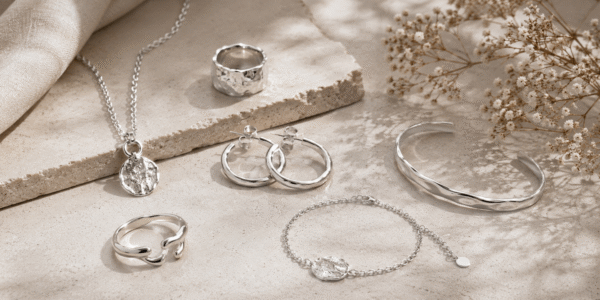
Handmade jewellery has a character that mass-produced accessories often struggle to reproduce. Small details in the surface, carefully considered shapes and the feel of a piece when it is worn can all contribute to a sense that the jewellery was created rather than simply manufactured.
That is particularly true of handmade silver jewellery.
Sterling silver has long been valued for its bright appearance, versatility and suitability for detailed jewellery making. When it is shaped and finished by skilled craftspeople, the material can become anything from a delicate everyday ring to a sculptural pair of earrings or a distinctive necklace.
But buying handmade silver jewellery is not simply about choosing the design you like most. Understanding the material, construction, finish and way a piece will be worn can help you choose jewellery that is both beautiful and practical.
This guide explains what to look for when buying handcrafted sterling silver jewellery, how to recognise quality, which styles work for different occasions and how to build a silver jewellery collection that feels personal rather than trend-driven.
Handmade silver jewellery refers to jewellery created using hands-on jewellery-making techniques rather than being produced entirely through automated mass manufacturing.
The exact process varies from one jeweller to another. A piece may involve traditional forming, soldering, filing, texturing, polishing, stone setting or other specialist techniques.
The important distinction is that craftsmanship plays a meaningful role in creating the finished piece.
This does not mean handmade jewellery is imperfect.
Quite the opposite.
Good craftsmanship is about controlling the details of a design while allowing the material to retain some of the character that makes individually crafted jewellery appealing.
Two handmade pieces based on the same design may have very subtle differences in surface texture or finishing. That individuality can be part of their appeal.
Most quality silver jewellery is made from sterling silver rather than pure silver.
Sterling silver contains 92.5% pure silver, with the remaining portion made up of other metals used to create a stronger and more practical alloy.
You may therefore see quality silver jewellery described as:
The number 925 refers to the 925 parts per thousand of pure silver in the alloy.
This makes sterling silver an excellent material for jewellery because it combines the natural appearance of silver with properties that make it more suitable for everyday designs.
Yes.
Sterling silver is genuine silver.
The fact that it contains other metals does not make it less real. Those additional metals are part of the alloy and help give the material the practical characteristics required for jewellery making.
This distinction is useful when comparing sterling silver with alternatives such as silver-plated jewellery.
With sterling silver, the material itself is a silver alloy.
With plated jewellery, the visible silver layer is applied over another material.
For someone looking to build a long-term jewellery collection, understanding that difference is important.
There are plenty of reasons to choose silver, but craftsmanship adds another dimension to the material.
Handmade jewellery can feel more personal because the finished piece reflects the making process.
Surface textures, shapes and small finishing details can give a design its own character.
Silver works beautifully across many jewellery styles.
It can be:
That makes sterling silver particularly useful for building a jewellery collection rather than buying a single statement piece.
Sterling silver generally offers a more accessible route into handcrafted jewellery than many high-purity precious-metal alternatives.
This means you can experiment with more designs and different styles while still choosing a genuine precious-metal material.
Silver has a naturally neutral appearance that works with a wide range of clothing colours.
It can look equally at home with casual outfits, tailoring or evening wear.
Not every mass-produced piece is poor quality, and not every handmade piece is automatically superior.
The difference is more nuanced.
Mass production is designed to create large quantities of identical jewellery efficiently.
Handmade jewellery places greater emphasis on the making and finishing of individual pieces.
This can affect:
The best way to judge handmade jewellery is still to assess the finished piece.
Look carefully at the details rather than assuming a label such as “handmade” tells you everything about quality.
When buying handcrafted sterling silver, the most useful question is not simply:
Does it look good?
Ask:
How well has it been made?
Several details can help you answer that.
Look at the silver surface closely.
A polished surface should feel intentional rather than uneven. A textured finish should appear deliberate rather than accidental.
Handmade does not mean unfinished.
Good craftsmanship should still produce a refined result.
Edges are often revealing.
On rings, pendants and earrings, poorly finished edges may feel sharp or uncomfortable.
Quality jewellery should generally feel comfortable when handled and worn.
Chains, earrings and bracelets often contain small connecting points that are essential to their durability.
Check how clasps, links and joins have been finished.
Small components should look secure rather than fragile.
Good jewellery design depends heavily on proportion.
A pendant should work with its chain.
An earring should balance visual impact with comfortable wear.
A ring should feel appropriate for the finger on which it is intended to sit.
These details can make a significant difference to the overall quality of a piece.
A ring can be one of the most expressive forms of silver jewellery because it is constantly visible to the wearer.
The right design depends on whether you want something understated or more distinctive.
Simple bands work beautifully for everyday wear.
They can be worn alone or combined with other rings.
Their simplicity also makes them easier to pair with different outfits.
Texture can give a relatively simple ring considerably more character.
Hammered, organic or sculptural surfaces can catch the light differently as the hand moves.
A statement ring can become the focal point of an outfit.
If the design is distinctive enough, you may not need much additional jewellery.
This can be particularly effective with minimalist clothing.
Earrings are among the most versatile pieces in a jewellery collection.
Because they sit close to the face, their shape can influence the overall impression of an outfit.
Small studs are excellent for everyday use.
They are discreet, easy to style and can work with almost any wardrobe.
Hoops have a stronger visual presence while remaining highly versatile.
Different diameters can create very different effects.
Small hoops can feel understated.
Larger hoops are more noticeable and can become an important part of your styling.
For something more distinctive, look for unusual shapes, organic curves or textured surfaces.
These designs can be particularly effective when the rest of your outfit is relatively simple.
A necklace can either support an outfit quietly or become its main focal point.
When choosing a handmade silver necklace, start with the neckline of the clothes you normally wear.
A shorter necklace can work beautifully with open necklines.
Longer styles can create a stronger vertical line and work particularly well with simple tops or dresses.
You should also consider whether the necklace will be worn alone or layered.
A delicate chain can be ideal for layering, while a larger pendant or sculptural design may work better on its own.
The necklace should also be proportionate to your body and wardrobe.
Jewellery does not need to be large to be noticeable.
Sometimes the smallest detail is enough.
Bracelets add movement to a jewellery collection.
Every time you move your hand, the jewellery catches light and changes position.
This makes texture particularly interesting in silver bracelets.
A smooth polished bracelet can create a clean and understated look.
A textured or organically shaped piece can feel more artistic.
For everyday wear, comfort should remain a priority.
The bracelet should move naturally with your wrist without constantly catching on clothing or getting in the way.
The best jewellery collection reflects the person wearing it.
Rather than choosing pieces because they are currently fashionable, think about the visual language you naturally prefer.
Choose:
Minimalist jewellery works particularly well when the design relies on proportion and texture rather than decoration.
Look for:
Classic pieces can often remain relevant for many years.
Try:
These designs can give a simple wardrobe more individuality.
Consider pieces inspired by:
Organic forms work beautifully with handcrafted silver because the material can be shaped and textured in expressive ways.
One of the advantages of sterling silver is its ability to move between different settings.
Choose pieces that are comfortable and easy to style.
Small hoops, simple rings and delicate necklaces are useful starting points.
Keep the overall appearance refined.
A simple silver necklace or a pair of understated earrings can add detail without distracting from your outfit.
This is where you can introduce more personality.
Try a larger earring, a statement ring or a more distinctive pendant.
Look for jewellery with stronger visual presence.
A sculptural silver piece can make a simple dress feel much more considered without requiring an entire matching set.
A good jewellery collection does not need to be large.
Start with the pieces you are most likely to wear.
A simple collection might include:
From there, add jewellery only when it fills a genuine gap.
This approach avoids buying several pieces that serve exactly the same purpose.
It also gives you the opportunity to discover your own style gradually.
Not necessarily.
Your jewellery does not have to come from the same collection or have identical details.
Different designs can work together when they share a similar sense of scale or finish.
For example, a simple silver chain can be paired with a more textured ring.
Minimal earrings can work with a statement bracelet.
A polished piece can sit alongside a textured one.
The aim is coordination rather than uniformity.
Absolutely.
Mixing metals has become a popular way to create a more relaxed and personal jewellery style.
Silver and gold can work particularly well together when there is some consistency in shape, proportion or texture.
For example, you might pair:
The key is intentionality.
The combination should look considered rather than accidental.
If most of your collection is silver, introducing one or two gold pieces can add warmth without changing the entire character of your jewellery.
Silver is often associated with cooler undertones, but there are no strict rules.
What matters most is how you feel wearing it.
Cooler complexions may find the bright appearance of silver particularly flattering.
Neutral undertones can usually work comfortably with both silver and gold.
Even warm skin tones can look excellent with silver, especially when the jewellery design suits the person’s overall style.
Personal preference matters more than rigid jewellery rules.
One of the most useful things to understand about sterling silver is that its appearance can change over time.
Silver can develop a darker surface layer known as tarnish.
This is a natural chemical reaction between silver and substances in the surrounding environment.
Tarnishing does not mean the jewellery is fake or poor quality.
It is one of the normal characteristics of silver.
Fortunately, appropriate cleaning can usually restore much of the metal’s original brightness.
In some cases, the gradual change in surface appearance can even become part of the character of a well-loved piece.
Handcrafted silver deserves sensible care, particularly when it has a delicate finish or detailed texture.
Perfume, cleaning products, chlorine and other chemicals can affect jewellery.
It is best to put your jewellery on after applying perfume and cosmetics.
Sports, gardening and manual work can expose rings and bracelets to unnecessary impact and friction.
Removing jewellery during these activities can reduce avoidable damage.
Silver jewellery can scratch against other jewellery.
Soft pouches or jewellery boxes with individual compartments can help.
Chains should also be stored carefully to prevent tangling.
Use an appropriate silver polishing cloth or jewellery-cleaning method suitable for the particular piece.
Avoid aggressive scrubbing, especially on deliberately textured or oxidised finishes.
Not every cleaning method is suitable for every gemstone.
Pearls in particular require more delicate care than sterling silver alone.
When a piece contains additional materials, follow the specific care instructions supplied by the jeweller.
This is an important distinction when shopping for silver.
| Feature | Sterling Silver | Silver Plated |
|---|---|---|
| Main material | 92.5% silver alloy | Base material with silver coating |
| Silver content | Throughout the silver component | Surface layer |
| Long-term wear | Designed as a silver jewellery material | Surface can wear over time |
| Maintenance | Normal silver care | Extra care may be needed to protect the coating |
| Value | Higher material value | Generally lower material value |
| Appearance | Genuine sterling silver surface | Silver appearance from plating |
Silver-plated jewellery can still be a useful option for certain budgets.
But if you are specifically looking for sterling silver jewellery, make sure you understand the construction before purchasing.
For many people, the answer is yes.
But “worth it” should not be based on the word handmade alone.
Think about the complete piece.
Consider:
A simple handmade silver ring that you wear several times a week may ultimately give you more value than a much more elaborate piece that rarely leaves the jewellery box.
The best purchase is usually the piece that fits naturally into your life.
When buying handmade silver jewellery in the UK, look for clear information about:
Buying from an established jewellery business can also make it easier to obtain accurate information about the piece and appropriate aftercare.
For higher-value purchases, pay attention to the documentation and product description rather than relying solely on photographs.
Silver is a beautiful material, but craftsmanship determines what the finished piece becomes.
Two pieces can use the same sterling silver and still feel completely different.
One may have carefully refined edges, balanced proportions and a subtle surface texture.
Another may look generic or poorly finished.
The difference lies in design and making.
That is why handcrafted jewellery can be particularly appealing to people who want pieces with a stronger sense of personality.
The material provides the foundation.
Craftsmanship gives it character.
Saras Fine Jewellery describes its collection as combining handcrafted sterling silver with its solid 18k gold jewellery, with a focus on designs that are elegant, timeless and distinctive. The brand also separates its silver offering across key jewellery categories including bracelets, earrings, necklaces and rings.
That makes silver a natural part of the broader Saras jewellery collection rather than simply an occasional alternative to gold.
For shoppers who prefer a cooler metal, enjoy a more contemporary appearance or want to explore handcrafted designs, sterling silver offers plenty of room for building a versatile collection.
Handmade silver jewellery offers a balance that is difficult to achieve with generic fashion accessories.
Sterling silver is a genuine precious-metal material with the versatility to support everything from simple everyday designs to more expressive statement pieces.
But choosing well means looking beyond the word “handmade”.
Consider the quality of the sterling silver, the construction, the finishing, the proportions and how comfortably the piece fits into your life.
A delicate necklace may become an everyday signature.
A pair of handmade silver earrings can become the piece you wear without thinking.
A textured ring may become something you associate with a particular period of your life.
That is where handmade jewellery becomes more than an accessory.
It becomes part of your personal collection.
At Saras Fine Jewellery, silver sits alongside the brand’s 18k gold offering as part of a collection built around thoughtful design and handcrafted jewellery.
Explore the Saras Silver Jewellery Collection and discover pieces designed to be worn, enjoyed and kept for years to come.
Handmade silver jewellery is jewellery created using hands-on jewellery-making techniques, with craftsmanship playing a significant role in shaping, constructing and finishing the piece.
If the jewellery is made from sterling silver, yes. Sterling silver is genuine silver containing 92.5% pure silver and is commonly identified by the 925 standard.
Yes. Sterling silver is commonly described as 925 silver because the alloy contains 925 parts pure silver per 1,000 parts.
Sterling silver can tarnish naturally over time. Tarnishing is a surface reaction and does not automatically indicate poor-quality silver. Proper storage and gentle cleaning can help maintain its appearance.
Many handmade silver pieces are suitable for regular wear, although the specific design matters. Rings and bracelets generally experience more physical contact than earrings or necklaces.
Yes. Silver and gold can be mixed to create a layered and contemporary look. Using similar proportions, shapes or textures can help the combination feel intentional.
Use a gentle silver-cleaning method appropriate for the individual piece. A suitable polishing cloth can help with tarnish, but textured, oxidised or gemstone-set jewellery may require more specialised care.
Yes. Silver jewellery can be a thoughtful gift because it is versatile and suitable for many personal styles. Choosing a design similar to jewellery the recipient already wears can make the gift more personal.