


14 September 2026
Read Article
Free Shipping on all UK orders | Shop Collection
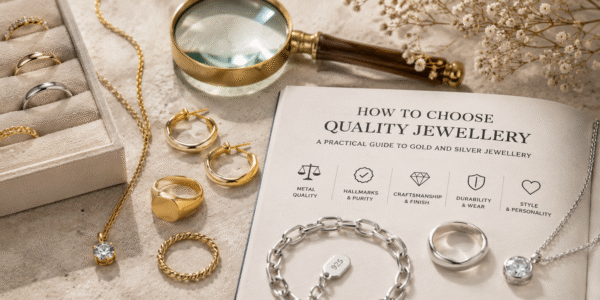
Buying jewellery can be surprisingly complicated. A necklace may look beautiful in a photograph, but that does not necessarily tell you much about the metal, craftsmanship, durability or how well it will hold up over time.
Whether you are buying a gold ring for everyday wear, a silver necklace as a gift, or simply adding a new piece to your collection, knowing how to choose quality jewellery can make the buying process much easier.
Here is a practical guide to what I think is actually worth checking before buying jewellery.
Good quality jewellery is not defined by price alone. The quality of a piece comes from several factors working together, including the metal used, its purity, the way it has been constructed, the quality of its finishing and how suitable it is for the way you intend to wear it.
A beautifully designed piece can still be disappointing if the construction is poor, while a relatively simple design can become a lasting part of a jewellery collection when it is made from good materials and finished carefully.
When learning how to choose quality jewellery, it helps to look beyond the photograph and consider what is underneath the design.
The first thing to check is what the jewellery is actually made from.
There is a big difference between:
Two pieces can look almost identical when they are new while having completely different characteristics.
For example, solid gold contains gold throughout the material rather than simply having a thin gold coating on the surface. This makes it particularly attractive for pieces intended for frequent or long-term wear.
Sterling silver is another popular choice. It offers the look and feel of precious metal at a considerably lower price than gold and can work beautifully for everyday jewellery.
For this reason, the first step when choosing quality jewellery is to identify exactly what metal you are buying and whether it is solid, plated or made from another type of construction.
If you are shopping for gold jewellery, you will often see terms such as 9ct, 14ct, 18ct and 22ct.
These numbers refer to the proportion of pure gold in the alloy.
18ct gold, for example, contains 75% pure gold, with the remaining 25% consisting of other metals added to give the jewellery the required strength and characteristics.
This is one reason 18ct gold is popular for fine jewellery. It offers a high gold content while still being suitable for jewellery applications.
However, higher purity does not automatically mean that a piece is the right choice for everyone.
Someone looking for a ring that will be worn during physically demanding activities may prioritise durability differently from someone buying an occasional necklace.
The important thing is to understand what you are buying rather than assuming that a higher number is always better.
In UK hallmarking terminology, 18ct gold corresponds to a fineness of 750, meaning 750 parts per thousand are gold. Other common gold standards include 9ct, marked 375, and 14ct, marked 585. These fineness numbers are useful when comparing gold jewellery because they tell you the proportion of precious metal in the alloy.
If you are buying precious-metal jewellery in the UK, hallmarks are worth paying attention to.
A hallmark provides information about the precious metal content and is an important form of consumer protection. UK government guidance recommends checking hallmarks when buying precious-metal jewellery.
Depending on the item, you may see marks indicating:
For example, a UK gold hallmark may include a fineness mark such as 375 for 9ct gold, 585 for 14ct gold or 750 for 18ct gold. Sterling silver is commonly represented by the 925 fineness mark.
A full UK hallmark also includes a sponsor’s or maker’s mark and an Assay Office mark. These marks provide more information than simply seeing a number stamped onto a piece of jewellery.
If a seller describes an item as gold or silver, but provides little information about its actual metal composition, that is a good reason to ask questions before purchasing.
One of the easiest mistakes when buying jewellery is choosing based entirely on appearance.
Instead, think about your actual lifestyle.
A delicate necklace might be perfect for occasional wear but less practical if you rarely take jewellery off.
A ring experiences considerably more contact with everyday objects than a pendant.
Earrings may need to be comfortable enough to wear for several hours.
Bracelets can experience friction against desks, clothing and other objects.
Ask yourself:
Will I wear this every day or occasionally?
Will it be exposed to water, perfume or cosmetics?
Does my lifestyle involve physical work or exercise?
Do I want something fashionable now or something I can wear for years?
These questions can be more useful than simply asking which metal is “best”.
Gold-plated jewellery can be an excellent way to experiment with different colours and designs without spending the same amount as you would on solid gold.
The important thing is to understand the difference.
With gold-plated jewellery, the gold is applied over another material. Over time, depending on the thickness of the plating and how the piece is used, the surface can show signs of wear.
Solid gold does not have this same surface layer that can simply wear away.
| Feature | Solid Gold | Gold-Plated |
|---|---|---|
| Construction | Gold throughout the material | Gold layer over another material |
| Surface wear | Does not rely on a plating layer | Plating can wear with use |
| Long-term use | Generally suited to long-term ownership | Depends on construction and care |
| Price | Usually higher | Usually more affordable |
| Best for | Long-term jewellery collections | Fashion and occasional wear |
Neither option is automatically better for every buyer. The right choice depends on how often you plan to wear the piece, your budget and whether you want a jewellery item for long-term ownership or something you may change more frequently.
That does not mean gold-plated jewellery is bad. It simply means the two products are designed for different expectations.
If you want affordable fashion jewellery that you change regularly, plating can make sense.
If you are looking for a long-term investment in a piece you expect to wear frequently, solid gold may be worth considering.
Gold gets most of the attention in jewellery discussions, but silver should not be overlooked.
Sterling silver is versatile, relatively affordable and works with almost any style.
It can be especially good for people who prefer:
One thing to remember is that silver can tarnish over time.
This does not necessarily mean that the jewellery is poor quality.
Tarnishing is a natural reaction between the silver alloy and substances in the environment. Proper storage and occasional cleaning can help keep silver jewellery looking its best.
Metal quality is only one part of a good piece of jewellery.
Look closely at the construction.
For a ring, check the edges and the inside of the band.
For earrings, look at the backs, posts and clasps.
For necklaces, inspect the chain, clasp and connections.
For bracelets, pay attention to how securely the individual components are joined.
Small details can tell you a lot about how much attention was given to the piece.
A beautiful design is great, but jewellery is ultimately something you wear on your body. Comfort and construction matter just as much as appearance.
Price alone does not determine quality, but an unusually low price should make you curious.
If a product is advertised as genuine precious-metal jewellery at a price that seems dramatically lower than comparable products, check the description carefully.
Look for information about:
A reputable seller should make it reasonably easy for you to understand what you are buying.
Online jewellery shopping can be convenient, but photographs can hide important details.
Before purchasing, look for multiple photographs and clear product specifications.
Ideally, you should be able to find information about:
Reviews can also be useful, but do not rely exclusively on star ratings.
Read what customers actually say.
Do they mention the quality?
Was the item comfortable?
Did the colour remain consistent?
Was the product accurately represented?
Was customer service helpful?
Those details can tell you considerably more than a five-star rating on its own.
Trends can be fun, but jewellery is often something people keep for considerably longer than a fashion cycle.
If you are spending more money on a piece, think about whether you will still enjoy wearing it in two or five years.
Classic shapes, simple chains, understated rings and versatile earrings can often become staples in a jewellery collection.
That does not mean you should avoid unusual designs.
It simply means that the best purchase is usually the one that fits your personal style rather than whatever happens to be trending this month.
Before pressing the “buy” button, ask yourself:
The last question might actually be the most important.
Good jewellery does not necessarily have to be the most expensive jewellery. The best choice is the piece whose materials, craftsmanship, design and price make sense for the way you intend to use it.
For anyone building a jewellery collection, understanding the difference between solid gold, plated jewellery and sterling silver is a much better starting point than simply searching for the cheapest option.
And once you know what you are looking at, shopping for jewellery becomes considerably less intimidating.
There is no single best metal for everyone. The right choice depends on your budget, lifestyle, preferred colour, desired durability and how frequently you plan to wear the piece.
Check the metal purity, hallmarking where applicable, construction, finishing and the information provided by the seller. In the UK, common gold fineness marks include 375 for 9ct and 750 for 18ct gold.
Yes. Sterling silver can be suitable for everyday jewellery, although it can tarnish over time and may require occasional cleaning and proper storage.
They serve different purposes. Solid gold is generally better suited to buyers looking for long-term ownership, while gold plating can offer a more affordable way to enjoy particular colours and designs.
750 is a millesimal fineness mark indicating 750 parts per thousand gold, corresponding to 18ct gold.
Check the exact metal, purity, dimensions, construction, gemstone information where relevant, hallmarking information, delivery terms and returns policy.