


20 October 2026
Read Article
Free Shipping on all UK orders | Shop Collection
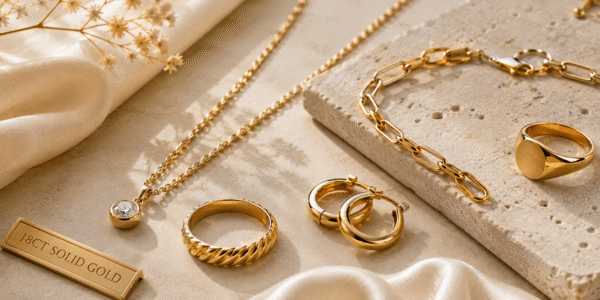
When shopping for fine jewellery, the words used to describe gold can make a significant difference. 18ct solid gold is one of the most sought-after options for buyers who want a high gold content without choosing almost-pure 24ct gold.
But what does 18ct solid gold actually mean?
The term describes two separate things. 18ct refers to the purity of the gold, while solid gold describes the material used to make the jewellery rather than a thin layer of gold applied over another metal.
An 18ct piece contains 75% pure gold, with the remaining 25% made up of other metals used to create an alloy suitable for jewellery. In the UK, 18ct gold corresponds to a fineness of 750, meaning 750 parts per thousand are gold.
For buyers, understanding this distinction is useful because 18ct solid gold sits in an interesting position: it offers considerably more gold than 9ct jewellery while remaining more practical for many jewellery applications than 24ct gold.
Whether you are considering an 18ct gold necklace, 18ct gold ring, pair of earrings or another fine jewellery piece, knowing what you are actually buying makes it much easier to judge quality, price and suitability.
The easiest way to understand 18ct solid gold is to separate the phrase into two parts.
18ct refers to gold purity.
Solid gold refers to the fact that the jewellery is made from a gold alloy throughout the relevant construction rather than simply having a surface coating of gold over another material.
Gold purity is traditionally expressed in carats, with 24ct representing pure gold. Since 18ct gold contains 18 parts gold out of 24, it contains 75% pure gold.
The remaining 25% consists of other metals. These metals are added because pure gold is relatively soft and can be difficult to use for jewellery that needs to maintain its shape and withstand everyday handling.
The exact metals used in an alloy can vary according to the desired properties and colour of the finished jewellery. This is why 18ct yellow gold, white gold and rose gold can look quite different even though they share the same gold purity.
In other words:
18ct tells you how much gold is in the alloy.
Solid gold tells you that gold is not merely a surface coating.
That distinction becomes particularly important when comparing 18ct solid gold with gold-plated or other surface-treated jewellery.
An 18ct gold alloy contains 75% pure gold.
The remaining 25% is made up of other metals that form the alloy.
This is also why you may see 750 stamped or described in relation to 18ct jewellery. The number represents 750 parts of gold per 1,000 parts of alloy.
In the UK hallmarking system, 750 is the recognised millesimal fineness associated with 18ct gold.
So if you see:
they can all refer to the same purity standard, although the way a particular piece is marked depends on the jewellery and applicable hallmarking requirements.
Yes. 18ct solid gold is real gold.
In fact, 18ct gold contains a relatively high proportion of pure gold compared with many commonly available jewellery alloys.
The term “solid” should not be confused with “24ct”. Solid gold does not mean that the jewellery is made from 100% pure gold. Instead, it indicates that the jewellery is not simply a thin layer of gold applied to a different core material.
An 18ct solid gold ring, for example, is made from an 18ct gold alloy rather than a base-metal ring with an 18ct gold coating.
This distinction matters because gold-plated jewellery and solid gold jewellery have fundamentally different constructions.
With plated jewellery, the visible gold layer is only part of the piece. With solid gold jewellery, the gold alloy forms the material of the jewellery itself.
For UK buyers, hallmarking provides an additional layer of consumer protection. The British Hallmarking Council explains that hallmarking independently verifies precious-metal content and helps buyers establish that jewellery is what it is described as being.
If pure gold is valuable, why isn’t jewellery simply made from 24ct gold?
The answer comes down largely to practicality.
24ct gold is extremely high in purity, but pure gold is also relatively soft. Jewellery is exposed to knocks, friction, pressure and repeated movement, particularly rings and bracelets.
Adding other metals creates an alloy with characteristics that make it more practical for jewellery manufacturing and everyday wear.
18ct gold therefore represents a deliberate balance.
It contains substantially more gold than 9ct gold while retaining the additional strength and workability provided by the other metals in the alloy.
For many buyers, that combination is one of the main reasons 18ct solid gold jewellery is associated with fine jewellery.
One of the most useful comparisons for UK jewellery shoppers is 18ct gold vs 9ct gold.
Both are legitimate gold alloys. The main difference is their gold content.
| Feature | 18ct Solid Gold | 9ct Gold |
|---|---|---|
| Gold purity | 75% | 37.5% |
| UK fineness | 750 | 375 |
| Gold content | Higher | Lower |
| Typical colour | Generally richer and warmer | Often paler, depending on alloy |
| Durability | Good, but relatively softer than lower-carat alloys | Generally harder and more resistant to some everyday wear |
| Price | Usually higher | Usually lower |
| Gold content per gram | Higher | Lower |
| Best suited to | Buyers prioritising higher gold content and fine jewellery | Buyers prioritising affordability and practical everyday jewellery |
There is no universal answer to which is “better”.
If your priority is obtaining a higher proportion of gold, 18ct solid gold is the clear choice.
If your priority is keeping the initial purchase price lower or choosing a harder alloy for a particularly active lifestyle, 9ct gold may be more appropriate.
The right choice depends on how the jewellery will be worn, your budget and what matters most to you.
Another common comparison is 18ct gold vs 14ct gold.
14ct gold contains 58.5% gold, while 18ct gold contains 75%.
That difference affects the composition, appearance and price of the finished jewellery.
| Feature | 18ct Gold | 14ct Gold |
|---|---|---|
| Gold purity | 75% | 58.5% |
| Fineness | 750 | 585 |
| Gold content | Higher | Lower |
| Colour | Usually richer | Usually somewhat less gold-rich in appearance |
| Hardness | Generally softer | Generally harder |
| Price | Generally higher | Generally lower |
| Typical appeal | Fine jewellery and higher gold content | Balance between gold content, durability and price |
Neither is automatically the better material.
For someone specifically searching for 18ct solid gold jewellery, the attraction is the higher gold content and the character of the metal. For someone primarily concerned with maximum resistance to everyday knocks at a lower price, 14ct can be an appealing alternative.
Yes, 18ct gold can be suitable for everyday wear, but the answer depends heavily on the type of jewellery.
The way a ring is worn is very different from the way a pair of earrings is worn.
Rings experience considerable contact with everyday objects.
They can rub against desks, door handles, bags, other jewellery and household items.
An 18ct gold ring can certainly be worn regularly, but a ring worn every day will naturally develop signs of wear over time. Polished surfaces may acquire fine scratches, and edges can become less sharp with prolonged use.
This is normal for precious-metal jewellery rather than evidence of poor quality.
Necklaces generally experience less direct impact than rings.
However, chains can experience repeated friction around the clasp, links and areas that come into contact with clothing.
An 18ct gold necklace can be an excellent everyday piece, particularly when the design and construction are appropriate for regular wear.
Earrings are often exposed to considerably less physical contact than rings.
For this reason, many styles of 18ct gold earrings can work particularly well as everyday jewellery.
The main consideration is often the design itself: delicate components may require more care than a simple, robust design regardless of gold purity.
Bracelets sit somewhere between necklaces and rings.
They move constantly with the wrist and can come into contact with desks, clothing and other objects.
If you wear an 18ct gold bracelet every day, expect the surface to acquire normal signs of wear over time.
18ct gold is durable enough for many forms of everyday jewellery, but it is not indestructible.
This distinction is worth making.
18ct gold is softer than lower-carat gold alloys because it contains a greater proportion of pure gold.
At the same time, it is substantially more practical for jewellery use than pure 24ct gold.
A useful way to think about it is as a spectrum:
24ct → highest gold purity, softer
18ct → high gold purity, practical for fine jewellery
14ct → lower gold purity, generally harder
9ct → lower gold purity, generally harder
This does not mean a 9ct ring will always survive better than an 18ct ring. Jewellery durability depends on far more than gold purity.
Design, thickness, construction, setting style, finishing and how the piece is worn all matter.
A well-designed 18ct gold piece can provide years of wear when treated appropriately.
The purity remains the same even when the colour changes.
The colour is influenced by the other metals incorporated into the alloy.
Yellow gold has the familiar warm gold appearance most people associate with traditional gold jewellery.
Because 18ct gold contains a high proportion of gold, its natural warmth can be particularly noticeable.
It works across classic and contemporary jewellery designs and pairs easily with other gold jewellery.
White gold is created by alloying gold with other metals to produce a paler appearance.
Many white-gold jewellery pieces are also finished with a surface treatment to achieve their bright white appearance. The exact construction and finishing can vary between pieces, so buyers should always check the product information supplied by the jeweller.
Rose gold has a warmer pinkish tone created through the composition of its alloy.
The colour can range from subtle blush tones to a more pronounced pink depending on the particular alloy and finishing.
The important point is that yellow, white and rose gold can all be 18ct gold.
The colour does not determine the purity.
If you are buying expensive jewellery, don’t rely solely on appearance.
Gold colour can be replicated. Weight can be misleading. Even a stamp on its own should be considered in context.
In the UK, hallmarking is particularly important.
This indicates an 18-carat gold standard.
This is another way of expressing 18-karat gold, commonly seen internationally.
This is the millesimal fineness associated with 18ct gold: 750 parts gold per 1,000.
A UK hallmark contains several marks that provide information about the jewellery and its testing.
The British Hallmarking Council explains that a complete UK hallmark includes a sponsor’s or maker’s mark, a metal and fineness mark, and an Assay Office mark.
For gold, the UK fineness standards include 375 for 9ct and 750 for 18ct.
There are also legal exemptions based on weight, so the absence of a physical hallmark does not automatically mean a particular item is fake. For gold, the current UK guidance gives a 1-gram exemption threshold.
When buying online, choose an established jeweller and look for clear information about the material, purity and hallmarking.
This is one of the most important distinctions to understand before buying jewellery.
| Feature | 18ct Solid Gold | Gold Plated |
|---|---|---|
| Construction | Gold alloy forms the jewellery material | Gold is applied as a surface layer |
| Gold content | 75% gold in an 18ct alloy | Depends on the underlying material and plating |
| Longevity | Designed as a precious-metal jewellery material | Surface layer can eventually wear |
| Maintenance | Normal jewellery care | Often requires greater care to protect the surface |
| Value | Generally higher due to gold content and construction | Generally lower |
| Price | Higher | Lower |
| Repair/resizing potential | Depends on design, but precious-metal construction allows jewellery-specific servicing | More limited depending on construction |
Gold-plated jewellery can be attractive and perfectly appropriate for certain budgets and styles.
The issue is simply that it should not be confused with 18ct solid gold.
The UK government also specifically distinguishes gold-plated articles from solid precious-metal articles, including rules governing how plated silver items can be described and marked.
For the right buyer, it can be.
But the price of a piece of jewellery should never be judged purely by the number of carats.
Two pieces can both be 18ct solid gold and have very different prices.
Why?
Because the final price can reflect:
This is why 18ct solid gold jewellery should be assessed as a finished piece rather than simply as a quantity of gold.
A lightweight, minimalist 18ct necklace and a heavily constructed 18ct statement necklace may contain very different amounts of precious metal and require very different levels of craftsmanship.
If you’re comparing pieces, look beyond the words “18ct”.
Consider the actual design, construction, weight where provided, finish, gemstone specifications where relevant, hallmarking and the reputation of the jeweller.
How to Choose the Perfect Gold Necklace
18ct gold does not need complicated maintenance, but good habits will help preserve its appearance.
Household cleaning products, chlorine and other chemicals can affect jewellery and may damage gemstones, finishes or other components.
It is sensible to remove jewellery before using strong cleaning products.
Rings and bracelets are particularly exposed during exercise, manual work and activities involving repeated impact.
Removing jewellery when appropriate reduces unnecessary scratches and knocks.
Gold jewellery can scratch other jewellery, and gemstones can also cause scratches.
Store individual pieces in a soft-lined jewellery box or pouch rather than leaving everything loose together.
For many gold jewellery pieces, gentle cleaning with warm water, mild soap and a soft cloth can help remove everyday residue.
Avoid aggressive scrubbing.
If a piece contains gemstones or delicate construction, follow the specific care advice provided by the jeweller.
Fine jewellery benefits from occasional professional inspection, particularly when it contains settings, moving components or gemstones.
A jeweller can identify wear that may not be obvious to the wearer and advise whether cleaning, polishing or repairs are appropriate.
18ct solid gold is particularly appealing to buyers who place a high value on gold content and fine-jewellery quality.
It can make sense if you:
However, 18ct is not automatically the right choice for everyone.
If budget is the dominant consideration, 9ct gold may offer a more accessible starting point.
If maximum hardness is your priority, a lower-carat alloy may sometimes be more suitable.
If you want the highest possible gold purity, 22ct or 24ct may be worth investigating, although those materials have different practical characteristics and are not necessarily ideal for every type of jewellery.
The best choice is the one that matches how you intend to wear the jewellery, what you value in the material and what you are comfortable spending.
Yes. 18ct solid gold is real gold containing 75% pure gold, with the remaining portion consisting of other metals that form the alloy. In the UK, 18ct corresponds to a fineness of 750.
Not necessarily for every buyer. 18ct contains substantially more gold, while 9ct is generally harder and more affordable. The better option depends on whether you prioritise gold content, budget, colour, durability or another characteristic.
Yes. Many types of 18ct gold jewellery can be worn every day. However, rings and bracelets experience more physical contact than earrings or necklaces, so normal scratching and signs of wear should be expected over time.
Pure gold itself is highly resistant to tarnishing, but 18ct gold is an alloy containing other metals. Its behaviour can therefore depend on the alloy composition, surface finish and environment. It should not be treated as completely immune to changes in appearance.
Not automatically. The 75% gold content does not by itself guarantee that every 18ct gold alloy will be suitable for someone with a particular metal sensitivity. The remaining metals in the alloy matter, so check the specific jewellery composition with the jeweller if this is a concern.
750 means 750 parts per thousand gold, which corresponds to 75% gold and the 18ct standard. It is the millesimal fineness associated with 18ct gold in the UK hallmarking system.
For buyers who value a higher gold content and fine-jewellery construction, 18ct gold can be an excellent choice. However, value should be assessed by considering the entire piece, including its weight, craftsmanship, design, gemstones and construction rather than purity alone.
For many uncomplicated pieces, gentle cleaning with warm water, mild soap and a soft cloth is suitable. Avoid harsh chemicals and abrasive materials. For jewellery containing gemstones or delicate components, follow the jeweller’s specific care instructions.
18ct solid gold is popular for a good reason: it combines a high gold content with the practical characteristics required for jewellery.
At 75% gold, it contains considerably more precious metal than 9ct gold, while the addition of other metals makes it more practical than pure 24ct gold for many jewellery applications.
But choosing 18ct gold should not simply come down to choosing the highest number.
The design, construction, weight, finish, intended use and quality of the finished jewellery all matter.
A beautifully made 18ct gold ring, 18ct gold necklace or pair of 18ct gold earrings should be considered as a complete piece of jewellery rather than simply as a percentage of gold.
For UK buyers, understanding hallmarks and the difference between solid and plated construction is equally important. The UK hallmarking system exists specifically to give consumers greater confidence in the precious-metal content of jewellery.
If you are considering 18ct solid gold jewellery, you can explore the gold collection at Saras Fine Jewellery to see how different designs, styles and pieces compare.